
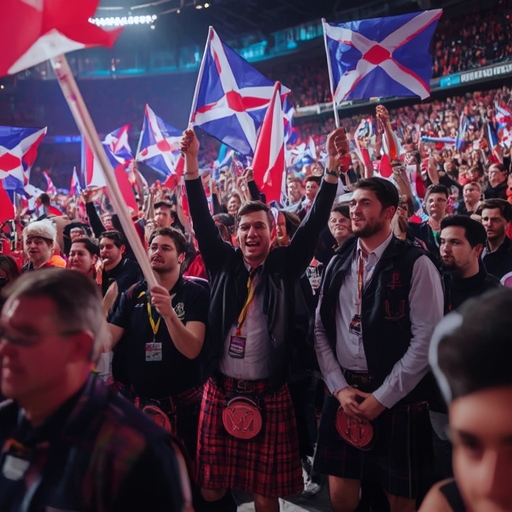
Scottish football supporters, affectionately known as the Tartan Army, have officially received FIFA’s authorization to wear their traditional sporrans alongside kilts during World Cup matches this summer, as the Scottish Football Association (SFA) has formally confirmed. This approval marks a symbolic gesture of respect for Scotland’s rich cultural heritage, merging national pride with the passion of sport on the world’s biggest stage.
Following a triumphant qualification campaign, thousands of loyal fans are now preparing to journey across the Atlantic to the United States, where they will enthusiastically back manager Steve Clarke’s men. Their appearance will carry historic significance, as it represents Scotland’s long-awaited return to the World Cup after a 28-year hiatus — the previous participation dating all the way back to 1998. This renewed presence has stirred immense excitement among supporters, whose allegiance and distinctive flair for celebration are recognized across global football.
Initially, FIFA’s stringent stadium security policies posed an unexpected obstacle for traditional dress. According to the World Cup’s official code of conduct, spectators are ordinarily permitted to bring only specific types of bags into the venues, with thorough limitations set on their size and material. Sporrans — the small pouches traditionally worn as part of Scotland’s national dress — were at first deemed to fall outside these permitted categories, primarily due to their opaque construction and the stringent safety regulations governing bag dimensions. However, after detailed discussions between the SFA and FIFA’s regulatory authorities, an accord was successfully reached. This agreement ensures that Scottish supporters can continue to wear their sporrans, provided they comply with standard security checks and inspections before entering the stadiums.
The tournament itself will encompass an expansive geographical scope, featuring matches across 16 host cities spanning the United States, Canada, and Mexico. Scotland’s fixtures are scheduled in Boston, where they will contend with Haiti and Morocco, and in Miami, where they are set to face Brazil — a series of encounters that promise to test both the team’s skill and spirit. The qualification for these fixtures was sealed in dramatic fashion last November, when Scotland triumphed over Denmark in a thrilling 4–2 victory at Hampden Park, igniting scenes of jubilation and reaffirming the depth of the nation’s footballing pride.
Under existing entry rules at the chosen venues, large bags are restricted to clear plastic containers no bigger than 30 centimetres by 30 centimetres by 15 centimetres. Small opaque bags, on the other hand, must not exceed 11 by 16.5 centimetres — dimensions notably smaller than many traditional sporrans. Without this newly granted exemption, supporters would have faced the disheartening prospect of leaving these symbolic accessories locked away outside or discarding them entirely, an outcome that would have undermined an integral piece of cultural identity woven deeply into the fabric of Scottish attire.
An SFA spokesperson expressed satisfaction with FIFA’s decision, emphasizing that the governing body had officially ratified the inclusion of sporrans following the necessary security inspections. In their statement, the spokesperson stressed ongoing cooperation between FIFA and the SFA to educate matchday staff about the unique nature of Scottish national dress, ensuring that fans wearing traditional garments will be welcomed with respect and understanding. They further highlighted that the ticketing and membership divisions of the SFA remain in continuous dialogue with tournament organizers to safeguard a hospitable and dignified experience for all Scotland fans attending the venues in Boston and Miami.
This development symbolizes more than a mere logistical concession; it stands as recognition that cultural expression can harmoniously coexist with modern event regulations. For the Tartan Army, the ability to don their complete regalia — kilts, sporrans, and all — transforms their attendance into a vibrant celebration of both identity and sport. The decision, therefore, not only enhances the fan experience but also reaffirms the global stage as a space where national traditions are acknowledged and embraced within the unifying spirit of football.
Sourse: https://www.bbc.com/news/articles/cn0erx6x228o?at_medium=RSS&at_campaign=rss